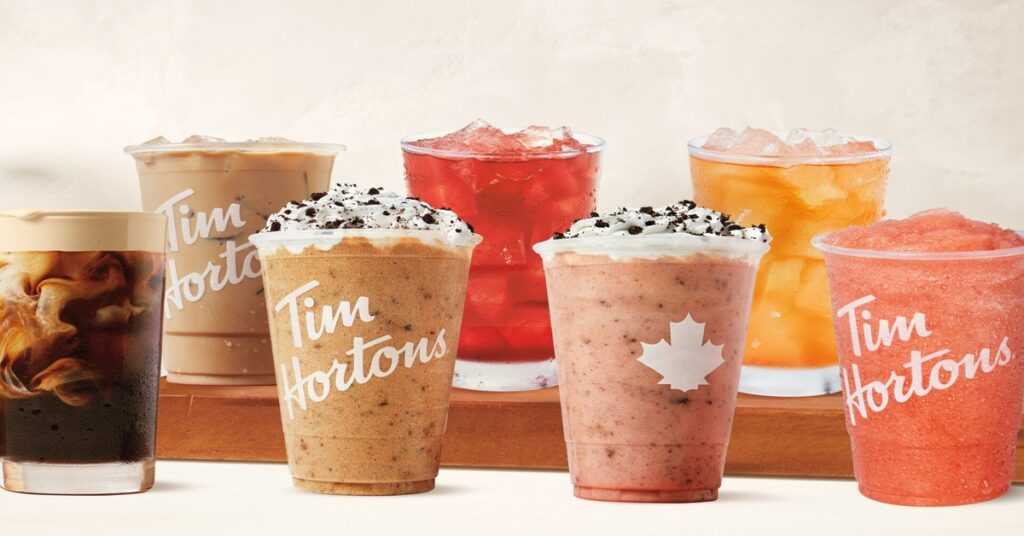
A plain Tim Hortons black coffee has 0 calories at every size — Small, Medium, Large, or Extra Large. Once cream and sugar are added, a classic double-double runs about 85 calories (Small) to 220 calories (Extra Large). Specialty drinks cost more: a Large French Vanilla is around 380 calories, and a Large Iced Capp can hit 430 calories. The lightest options besides black coffee are the Americano (under 20 calories) and Iced Capp Light (150–280 calories).
Grabbing a coffee on the way to work sounds simple enough, until you actually stand at the counter and realize there are about six sizes, three or four blends, and a dozen ways to dress it up with cream, sugar, or flavor shots.
Anyone who has stood in that line during a busy morning rush knows the feeling of ordering “a medium double-double” out of pure habit, without ever thinking about what that actually adds up to calorie-wise. This guide breaks it all down, size by size and blend by blend, so the next trip to Tim Hortons feels a lot less like guesswork.
Why Coffee Calories Actually Matter More Than People Think
A lot of people assume black coffee is basically “free” calorie-wise, and that is mostly true. But the moment cream, sugar, flavored syrup, or milk enters the cup, the numbers start climbing fast.
Someone who orders a large double-double every single morning for a year is drinking a very different amount of calories than someone who orders the same size in black coffee. Over a week, that gap can be the difference of a small meal. Over a month, it starts looking like a real dent in a calorie budget.
This matters even more for people who are tracking their intake for weight loss, diabetes management, or just general health awareness. A daily coffee habit is often the “hidden” part of someone’s diet, the part they forget to log because it feels like a drink rather than food. Understanding the real numbers helps people make small swaps that add up to a big difference over time.
Tim Hortons Cup Sizes Explained
Before comparing calories, it helps to know exactly what each size actually means in ounces, because “small,” “medium,” and “large” can vary a lot between coffee chains.
- Small: 10 fl oz
- Medium: 14 fl oz
- Large: 20 fl oz
- Extra Large: 24 fl oz
Some locations also offer a smaller 8 oz kids’ size and specialty cups for iced drinks, which tend to run slightly different in volume because of ice displacement. Keeping these sizes in mind makes the calorie comparisons below much easier to follow, since the base coffee itself barely changes in calories, but what gets added to it changes everything.
Original Blend Coffee: The Baseline
The Original Blend is the coffee most people picture when they think of Tim Hortons. It is medium roast, smooth, and the most ordered item on the entire menu. Black, with nothing added, this coffee is close to calorie-free across every size.
- Small Original Blend (black): 0 calories
- Medium Original Blend (black): 0 calories
- Large Original Blend (black): 0 calories
- Extra Large Original Blend (black): 0 calories
That is the good news. Black coffee, no matter the size, will not add meaningful calories to a day. The calorie count only starts moving once milk, cream, sugar, or flavor gets added, which is where most people’s daily order actually lands.
What a “Double-Double” Really Costs
The classic Canadian order, a double-double means two creams and two sugars. It sounds small, but it adds up more than most people expect, especially at the larger sizes.
- Small double-double: roughly 80 to 90 calories
- Medium double-double: roughly 110 to 130 calories
- Large double-double: roughly 150 to 180 calories
- Extra Large double-double: roughly 190 to 220 calories
For someone who orders this every single morning, that large size alone can mean over 1,000 extra calories a week just from coffee. It is not a huge number in isolation, but for anyone watching their intake closely, it is worth knowing.
Double Cream, Single Cream, and Other Common Orders
Not everyone goes for the classic double-double. Here is how some of the other popular customizations stack up.
Single Cream, Single Sugar
- Small: around 45 calories
- Medium: around 60 calories
- Large: around 80 calories
Cream Only (No Sugar)
- Small: around 35 calories
- Medium: around 45 calories
- Large: around 60 calories
Milk Instead of Cream Swapping cream for milk cuts calories noticeably, since cream is much higher in fat content than milk. A medium coffee with milk and sugar typically lands around 50 to 70 calories, compared to the 110 to 130 calories of a cream-based double-double at the same size.
This small swap is one of the easiest changes for anyone trying to trim calories without giving up their coffee ritual entirely.
Dark Roast vs Original Blend: Does It Change Anything?
A lot of customers assume Dark Roast is somehow “stronger” or “heavier,” which leads them to think it might carry more calories. In reality, the roast level has almost nothing to do with calorie content. Both Dark Roast and Original Blend, when ordered black, sit at 0 calories regardless of size.
The real difference between the two is flavor and caffeine strength, not calories. Dark Roast has a bolder, slightly smokier taste, while Original Blend is smoother and milder. So the calorie comparison really comes down to what gets added, not which blend is chosen.
Decaf Coffee Calories
Decaf drinkers often wonder if removing caffeine changes the calorie count. It does not. Decaf coffee, whether small, medium, or large, follows the exact same calorie pattern as regular black coffee: 0 calories on its own. The calorie count only shifts once cream, sugar, or flavoring gets added, just like with regular coffee.
This is good news for anyone who switched to decaf for health reasons and was worried it might come with a hidden calorie cost. It does not.
Flavored Coffee and Specialty Blends
This is where things start to shift more noticeably. Tim Hortons regularly rotates seasonal and specialty flavors, and these tend to carry a lot more calories than a standard cup.
French Vanilla Coffee (made with a sweetened creamer base rather than plain cream)
- Small: around 200 calories
- Medium: around 280 calories
- Large: around 380 calories
Vanilla-flavored shots added to regular coffee typically add around 15 to 20 calories per pump, which is a smaller addition compared to a fully creamer-based French Vanilla order.
The takeaway here is that French Vanilla is really more of a dessert-style coffee than a traditional black coffee with a splash of flavor. It is delicious, but the calorie jump is significant, especially at larger sizes.
Iced Coffee and Iced Capp Comparisons
Cold coffee drinks tend to surprise people the most, since they often come loaded with sweetened bases.
Iced Coffee (with cream and sugar)
- Small: around 90 calories
- Medium: around 130 calories
- Large: around 170 calories
Iced Capp (Original) This is a completely different category, since Iced Capp is blended with a sweetened dairy base rather than being brewed coffee with add-ins.
- Small: around 220 calories
- Medium: around 330 calories
- Large: around 430 calories
Iced Capp Light
- Small: around 150 calories
- Medium: around 220 calories
- Large: around 280 calories
Anyone choosing between a regular Iced Capp and the Light version can save a meaningful amount of calories, often over 100 calories at the medium and large sizes, just by picking the lighter option.
Espresso-Based Drinks: Lattes, Cappuccinos, and Americanos
Tim Hortons also offers a full espresso lineup, and these drinks behave very differently from drip coffee because they are built on steamed milk rather than brewed coffee with a splash of cream.
Americano (espresso and hot water, no milk)
- Small: around 10 calories
- Medium: around 15 calories
- Large: around 20 calories
This is one of the lowest-calorie hot drinks on the entire menu for anyone who wants something stronger than drip coffee without the calorie load of milk-based drinks.
Latte (with 2% milk)
- Small: around 120 calories
- Medium: around 170 calories
- Large: around 230 calories
Cappuccino (with 2% milk)
- Small: around 80 calories
- Medium: around 110 calories
- Large: around 150 calories
Cappuccinos come in lower than lattes at the same size because they use more foam and less steamed milk, meaning less liquid dairy overall in the cup.
A Simple Side-By-Side Table
| Drink Type | Small | Medium | Large |
|---|---|---|---|
| Black Coffee | 0 cal | 0 cal | 0 cal |
| Double-Double | ~85 cal | ~120 cal | ~165 cal |
| Cream Only | ~35 cal | ~45 cal | ~60 cal |
| French Vanilla | ~200 cal | ~280 cal | ~380 cal |
| Iced Coffee (cream/sugar) | ~90 cal | ~130 cal | ~170 cal |
| Iced Capp Original | ~220 cal | ~330 cal | ~430 cal |
| Iced Capp Light | ~150 cal | ~220 cal | ~280 cal |
| Americano | ~10 cal | ~15 cal | ~20 cal |
| Latte (2% milk) | ~120 cal | ~170 cal | ~230 cal |
| Cappuccino (2% milk) | ~80 cal | ~110 cal | ~150 cal |
This kind of side-by-side view makes it much easier to spot the pattern: plain brewed coffee stays low no matter the size, while anything built on a sweetened base or steamed milk climbs quickly, and climbs even faster as the size goes up.
Real Experience: What Ordering Actually Looks Like
Standing in line at a busy Tim Hortons on a Monday morning, it becomes pretty obvious that most people order out of habit rather than really thinking about the menu board.
The person ahead orders a “medium, regular,” which in Tim Hortons language usually means one cream and one sugar, not realizing that this small habit repeated daily adds up over months.
The next person orders a large French Vanilla without hesitation, treating it more like a treat than a coffee, which is honestly a fair way to think about it once the calorie numbers are known.
What becomes clear after paying attention to these orders over time is that most of the calorie difference comes down to two decisions: the size chosen and whether the drink is built on brewed coffee versus a sweetened or steamed-milk base.
Someone who always orders a large Iced Capp is consuming a completely different amount of calories than someone who always orders a large black coffee, even though both people would describe their order as “just getting a coffee.”
Tips For Cutting Calories Without Giving Up Coffee
For anyone who loves their daily coffee run but wants to trim some calories, a few small changes make a real difference without requiring a full menu overhaul.
Switch cream for milk. This alone can cut a meaningful chunk of calories from a double-double style order, especially at medium and large sizes.
Choose Iced Capp Light over the original. The calorie savings are significant, often well over 100 calories, while still keeping that familiar blended texture.
Ask for one sugar instead of two. Cutting sugar in half across a daily order adds up meaningfully across a month.
Pick Americano over latte when possible. For anyone who likes a stronger coffee flavor without the milk-heavy calorie load, Americano is one of the lightest options on the whole menu.
Downsize by one size. Moving from a large to a medium, or a medium to a small, on any customized drink automatically lowers the calorie count without changing the flavor profile at all.
None of these require giving up coffee entirely, which is usually the sticking point for most people. Small swaps tend to stick better than big, dramatic changes anyway.
How Seasonal Drinks Change The Picture
Seasonal specialty drinks, like pumpkin spice lattes in the fall or peppermint mocha style drinks around the holidays, tend to carry noticeably higher calorie counts than the standard year-round menu.
These drinks are built with flavored syrups and often whipped cream on top, which pushes a medium size drink well past 300 or 400 calories in many cases.
Anyone trying to enjoy these seasonal treats without derailing their regular eating habits might consider ordering a smaller size, asking for no whipped cream, or treating it as an occasional order rather than a daily habit during that season.
There is nothing wrong with enjoying a seasonal favorite, but knowing the calorie weight ahead of time helps make it a choice rather than a surprise.
Why Checking Exact Numbers Still Matters
The numbers above give a solid general picture, but exact calorie counts can shift slightly based on regional menu differences, specific milk types used, and any recipe updates over time. For anyone who wants precise, up-to-date numbers based on their exact order, using a Tim Hortons Calories Calculator makes it easy to plug in the specific size, blend, and add-ins to get an accurate total instead of relying on rough estimates.
This is especially useful for people who order a slightly unusual combination, like a large coffee with three creams and one sugar, since general averages will not capture that exact combination the way a calculator built specifically around the Tim Hortons menu can.
Common Questions People Ask At The Counter
Spend enough mornings around a Tim Hortons counter and the same handful of questions keep coming up, either from customers thinking out loud or from staff explaining the menu to someone ordering for the first time.
Does a bigger size always mean more calories, even for black coffee? No. This is one of the most misunderstood points on the whole menu. A large black coffee and a small black coffee are both 0 calories, because the coffee itself has no calories. Size only starts to matter once cream, sugar, or a flavored base gets added, since those ingredients scale up with the cup size.
Is Dark Roast lower in calories than Original Blend? Not at all, and this trips up a lot of first-time orderers. Roast level changes flavor and caffeine intensity, not calorie count. Both blends sit at 0 calories when ordered black, regardless of size.
Which drink on the menu has the fewest calories besides plain black coffee? The Americano is usually the answer here. Because it is just espresso and hot water with no milk, it stays under 20 calories even at the large size, making it a good middle ground for anyone who wants more intensity than drip coffee without the calorie load of a milk-based drink.
Is oat milk or almond milk lower in calories than dairy milk? It depends on the type chosen and the brand used at a given location, since plant-based milk options can vary more than people expect. Generally, unsweetened plant-based milk options tend to run close to or slightly below 2% dairy milk in calories, but sweetened versions can actually run higher. Checking the exact substitution through a calculator is the most reliable way to know for sure, rather than assuming plant-based automatically means fewer calories.
Does ordering “extra cream” really make a noticeable difference? Yes, more than most people expect. Each additional cream typically adds somewhere in the range of 15 to 20 calories, so an order of “triple-triple” instead of a standard double-double can add up quickly, especially at the larger sizes where the effect compounds.
A Closer Look At Why This Menu Is So Easy To Underestimate
One of the more interesting patterns to notice after paying close attention to orders over time is how differently people treat coffee compared to food. A customer who would think twice about ordering a 400-calorie dessert will often order a large Iced Capp without a second thought, even though the calorie count can land in a very similar range.
Coffee occupies this strange mental category where it feels like “just a drink,” even when the actual ingredients closely resemble a milkshake or a sweetened dessert beverage.
This is not a criticism of anyone’s ordering habits. It is simply a pattern worth being aware of, especially for anyone trying to build a clearer picture of their daily intake.
A person who tracks their lunch and dinner carefully but skips logging their morning coffee run is often missing a bigger piece of the picture than they realize, particularly if that order includes cream, sugar, or a specialty base.
Recognizing this pattern is often the first step toward making small, sustainable changes. Nobody needs to give up their coffee order entirely. It is usually enough to simply know what is actually in the cup, so the choice becomes intentional rather than automatic.
Putting The Numbers Into Everyday Context
To make the numbers feel more concrete, it helps to compare them to familiar foods. A medium double-double, at roughly 120 calories, is fairly close to a slice of toast with a thin layer of butter. A large Iced Capp, at roughly 430 calories, is closer to a full fast food side meal than a simple beverage. A small Americano, at around 10 calories, is close enough to zero that it barely registers on a daily total at all.
Framing coffee calories against everyday food references like this tends to make the numbers click in a way that raw calorie counts alone sometimes do not. It also makes it easier to decide where a coffee order fits into the rest of a day’s meals, rather than treating it as something separate from food entirely.
Summary
Tim Hortons coffee calories depend almost entirely on size and what’s added, not the roast itself. Plain black coffee — Original Blend, Dark Roast, or Decaf — stays at 0 calories in every size, from Small (10 oz) to Extra Large (24 oz). A classic double-double runs 85 to 220 calories, while specialty drinks like French Vanilla and Iced Capp climb much higher, up to ~430 calories for a Large Iced Capp.
- Black coffee (any size/roast): 0 calories
- Double-double: ~85–220 calories
- French Vanilla: ~200–380 calories
- Iced Capp Original: ~220–430 calories
- Iced Capp Light: ~150–280 calories
- Americano: ~10–20 calories (lowest specialty option)
- Latte / Cappuccino (2% milk): ~80–230 calories
Bringing It All Together
Coffee at Tim Hortons can range from 0 calories for a plain black coffee all the way up to over 400 calories for a large specialty drink, and the difference almost always comes down to two things: the size ordered and what gets added to the cup. Black coffee and Americanos stay light no matter the size. Classic additions like a double-double sit in a moderate middle ground. Specialty and blended drinks, especially the sweetened ones like French Vanilla and Iced Capp, carry the biggest calorie load, particularly at large and extra-large sizes.
None of this means specialty drinks are off-limits. It simply means knowing the numbers ahead of time turns a daily habit into an informed choice. Whether the goal is cutting calories, managing a health condition, or just being curious about what is actually in that daily cup, understanding these numbers makes the whole experience a lot more transparent. The next trip to the counter does not have to involve any guesswork at all.